
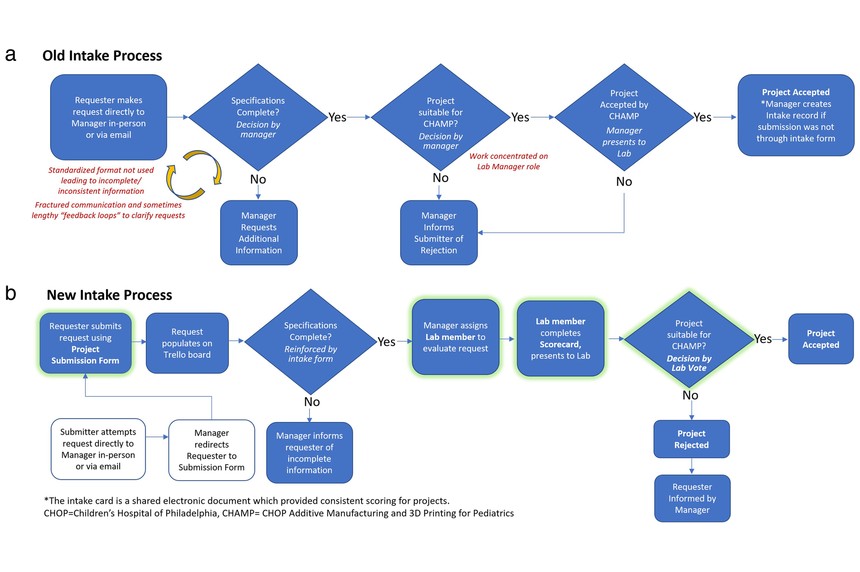
Our client required support in designing and implementing a new request intake process aimed at reducing cycle time for providing estimates and quotes, delivering clearly defined services to the business, improving demand and resource planning accuracy, and aligning the entire organization to a service-oriented model that supports the new process.
Revamping the Internal Order Intake Process
Service Provided
Capabilities Utilized
Continuous Process Improvement Organizational Change Management
Client challenge
The IT application services department of a Fortune 50 pharmaceutical conglomerate was struggling to efficiently address the business’s needs for initiating, approving, and completing project requests. The department lacked global controls, roles, and tools essential for managing application services initiatives, leading to long delays and unmet expectations. A more effective request model was needed to better communicate the capabilities of the application services team and fulfill business needs more quickly, consistently, and with improved outcomes.
Our solution
The Valtree team restructured the application services organization into service-based roles using ITIL fundamentals, then designed a revamped order intake process that centralized all application services orders, offering a standardized and streamlined ordering experience for all business and service customers. To ensure successful adoption, we established three global support centers to fully implement the new process and changes.
Results
By introducing the new order intake process, service request cycle times were cut by over 70%, leading to higher satisfaction levels, increased project completion rates, and total savings of $1.1 million.
Additional Case Studies
Launching a Usage-Based Pricing Model for an AI Developer Platform
An AI developer platform’s flat-tier pricing was leaving money on the table with its largest customers
Establishing an Enterprise AI PMO to Track ROI Across 30 Initiatives
A global enterprise had 30 active AI initiatives across its business units but no consistent way
Building the Product Operating Model for an Agentic SaaS Vendor
A vertical SaaS vendor had shipped an early agentic feature that could autonomously complete customer workflows,